
Organising website content sensibly
I wrote this post a while back. The content can still be relevant but the information I've linked to may not be available.
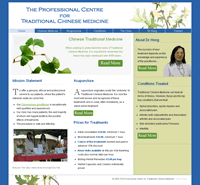 We were asked to design a new website for The Professional Centre for Traditional Chinese Medicine for 2009. The new website launched last week.
During the website development, there was some discussion about how many pages would be required. The website copy was provided by the client and it seemed to organise itself naturally into seven pages but there was a brief period of discussion about whether less pages would be better. In these cases, I generally err on the side of more pages with less content rather than less pages with more on each. This is not a hard and fast rule because it makes no sense if the content is split up needlessly. However, in general, I try and organise website page content and the overall website structure into reasonably small and sensible sections because it seems to me to be more easily read and navigated that way.
Of course, when organising your website content, you also need to consider search engines. There is an SEO school of thought that says you should aim for a specific number of words per page and that pages with less than 100-200 words do not have enough text for search engines [for example, What's the ideal word count?]. I'm not totally convinced by this but I think it's better to organise things as sensibly as you can for your intended web visitors [of the human kind] rather than rigidly following a specific guideline.
Comments are OFF for this post.